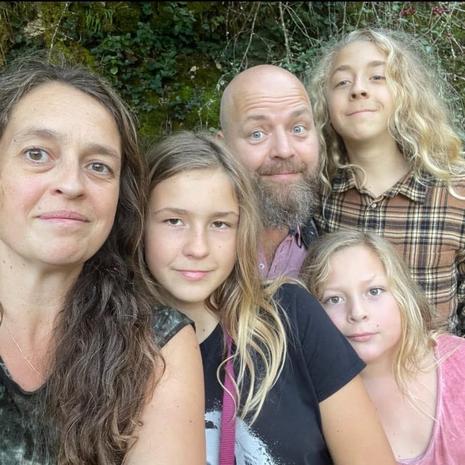
There is no doubt that our own fathers did their best. Still, many of us grew up with fathers who did not talk about feelings and who could not guide us in the role we now find ourselves in as fathers.
As a young father, I missed experience. I missed words for what was happening inside me. I missed an understanding of attachment — and of how it is possible to be a father in a different way, grounded in love rather than control.
Not because I didn’t love my children, but because I didn’t know better.

Together with my wife, Cecilie Conrad, I host the podcast Self Directed. It is an ongoing, guest-based podcast with more than 150 episodes, where we speak with authors, thinkers, and practitioners about parenting, relationships, learning, and family life. One of our guests was Gordon Neufeld.
After that conversation, I reached out to Gordon with a wish to support the sharing of his attachment-based developmental approach.
Our talk became the beginning of a long collaboration. Today, I work closely with Gordon as Marketing Director at The Neufeld Institute, while continuing to deepen my understanding of his work through the Institute’s courses, including his Foundational Studies.
When I read 'Hold On to Your Kids', and later dived deeper into the Neufeld Approach, it didn’t feel like learning something new. It felt more like coming home. It felt natural — like finally getting words for something that had been just out of reach. Something I had sensed, but could now see more clearly because I had language for it.
It shifted how I looked at development. Less as something adults are supposed to make happen, and more as something that takes place when the conditions are right.
From there, fatherhood stopped being about shaping or correcting children. It became more about the relationship. About noticing what might be missing, and taking responsibility for that — rather than trying to fix the child.

Life with Cecilie has taught me a lot. About relationships. About parenting. One of the pieces of advice I often give men is this: listen to your wife. She has usually thought a whole lot more about this parenting thing than you have and read a lot more. I know that living with Cecilie has shaped much of how I understand my role as a father.
Cecilie is a trained psychologist and works as a parent consultant for women. And sharing our live together, I have gotten to see the world through her lens, see how she thinks, how she listens, how she cuts through to what is actually going on. Over time, that shapes you. Not as a theory thing. More as… You live together, and you learn.
She was also the one who really pushed for us to travel full-time. To stop thinking of “family” as something that happens inside a house, and instead see it as something you live in relationships and in community. That shift has meant a lot for us. For me.

Cecilie and me together with our three youngest (who are all grown now).
The illness changed our lives. We chose life, family, and being together as what mattered most. In 2012, we received a life-giving surprise when our youngest, Fjord, was born. I took full parental leave and stayed home with a baby for twelve months. A real gift.
Me and my oldest (now adult) daughter Liv Ea
Living closely with others becomes a mirror—you see yourself, sometimes it's not fun to look in the mirror. But you learn and grow.
Today, I am the provider, stay-at-home dad, deeply present dad, but I have also been the stressed-out career dad who came home late. The tired dad. The dad is carrying guilt. I have made many mistakes along the way, shouted, been stubborn, and I have had to learn, adjust, and take responsibility again and again.
It is from this lived fatherhood that I meet other fathers.

The bus we bought, which ended up becoming our tiny home, parked beside an animal sanctuary near Barcelona.
I don’t believe parents were meant to carry the task of parenting on their own.
In Gordon Neufeld’s work, he speaks about what he calls the attachment village — the simple idea that children, and parents, develop best inside a network of close relationships. When the conditions are right, attachment roots can take hold and unfold.
But this is no longer how most families live.
For many, the attachment village is gone. The nuclear family has become an isolated unit, where two adults — often far from extended family — are expected to carry everything themselves